Time flies with great content! Renew in to keep enjoying all our premium content.
Prime
Clearing agents protest high fees and slow service
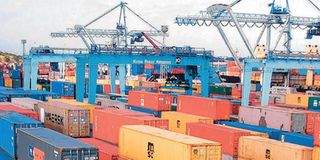
Container Freight Stations are said to be grappling with congestion at the Mombasa port but clearing agents charge that this is a deliberate move to accumulate storage charges. Photo/FILE
Container Freight Stations (CFSs) are grappling with congestion at the Mombasa port as questions arise as to why additional cargo is being directed toward them despite the yard operating at half capacity.
The slow pace of clearing cargo from the CFSs is seen by clearing agents a deliberate move to accumulate storage charges after the free storage period was reduced from seven to five days early this month.
“Due to shortage of trucks, two days may be lost before cargo is moved to a CFSs for clearing to commence as the free storage period begins when the last container is offloaded from the ship at the port,” said Mr Nicholas Omondi, operations supervisor at General Cargo Services.
At the Mombasa Container Terminal (MCT), where agents recently protested in order to get accumulated storage charges waived, they claimed that the CFS was handling over 2,000 containers in the yard against a capacity of 1,500.
“For two days, there was no crane working and containers could not be loaded onto the trucks,” said Omondi, adding that the congestion had reduced space to the extent that it was even difficult for a truck to turn, leading to a slow off-take and further delays.
According to operations manager at MCT, Mr Karl Ric, the number of containers at the facility was less than 2,000 although he declined to comment further on the matter.
He also declined to address the question of the charges that the facility is alleged to charge.
Importers pay a storage fee of $25 for the first 3 days after the free storage period and $30 for the next 10 days for a 20-foot container.
After 21 days, the cargo is supposed to go to Kenya Revenue Authority (KRA) warehouse, where Customs Warehouse Rent (CWR) is paid.
Beginning October 1st this year, the port reduced the free storage period and scrapped scanning, verification and inspection fees of Sh5,850 and Sh8,580 for 20-foot and 40-foot containers respectively.
But according to Mr Peter Mambembe, vice chairman of the Kenya International Freight and Warehousing Association (Kifwa), CFSs have instead introduced new cargo handling charges of $75 for a 20-foot container to recover the lost revenue.
An invoice seen by Business Daily indicates that a similar charge is paid to Kenya Ports Authority (KPA).
There is also remarshaling charges for overstayed cargo, which Omondi said was as a result of moving a container from one point to another.
For instance, an importer would pay $740 for a 40-foot container- both handling charges and accumulated storage fee – nearly double the $339 payable if the container was cleared at the port.
Since October 2007 when the port experienced serious congestion, causing shipping lines to threaten to slap the punitive Vessel Delay Surcharge (VDS) on KPA, CFSs, which are 100 per cent owned by the private sector, have evolved into custom bonded facilities without commensurate regulations to guide their operations.
Unscrupulous businessmen
According to Mr Mambembe, CFSs generate income from the hefty charges they levy on importers.
They have become one of the most lucrative businesses in Mombasa.
“CFS’s charge their own rates contrary to an agreement they signed with KPA that binds them to use the authority’s tariff since they are an extension of the port,” said Mambembe.
The clamour to set up the facilities has pushed land prices high as businessmen scramble for the limited land available within a 10-kilometre radius of the port.
Currently, there are 14 Kenya Revenue Authority (KRA) licensed CFSs, all of which have offices for use by customs officers.
But, according to KPA, only four of them– Consolbase, Mombasa Container Terminal, the Boss Freight and Mitchell Cotts –have the authority to receive cargo directly from ships.
The rest can only be used as facilities for storing cleared cargo and empty containers.
Owing to the confusion that exists in their operations, importers have sounded alarm bells that the facilities are doing business in so ad hoc a manner as to be susceptible to unscrupulous businessmen who use them for carry out shady deals.
Delays at CFSs are also caused by insufficient facilities such as verification equipment and other logistical problems including lack of sufficient parking space for trucks, Mr Mambembe said.
“The issue of delay at CFSs has in the past been raised at weekly port stakeholders’ meetings,” KPA public relations manager Mr Benard Osero admitted.
Industry players have recommended the regulation of CFSs by a third party outside KRA and KPA who is not involved in the cargo clearance value chain.
The new Merchant Shipping Act 2009 provides a window for this and the ministry of transport together with Kenya Maritime Authority (KMA) have embarked on the process of creating a legal framework to regulate the industry.
In March this year, Kifwa threatened to take legal action against shipping lines that offloaded their cargo to nominated CFSs without prior consultation with cargo owners arguing that it was illegal.
“The role of the CFSs has been reversed and cargo from the vessels is being sent to the preferred CFSs upon discharge although the bill of lading declares the discharge port as Kilindini,” Mambembe said.
“Our clients goods are normally destined to Kilindini Port as the place of final delivery and it is contrary to the provisions of the law as stipulated in the East African Community Customs Management Act (EACCMA) to amend the manifest to read otherwise without following the laid down procedures,” Mambembe said in a letter to the shipping lines.
The agents have complained that CFSs continued charging storage fees after 21 days when customs warehouse rent (CWR) become due.
The difference in tariffs applied by KPA and the CFSs has come to fore severally, especially on the occasions when KRA’s auctions have overstayed cargo at the CFSs.
Those who win bids are required to pay storage fee to CFS operators.
Unlock a world of exclusive content today!Unlock a world of exclusive content today!